




| Getting your Trinity Audio player ready... |
Key Takeaways:
- China currently trails the United States by only 4,012 BTC, signaling a potential shift in the global digital asset hierarchy.
- The U.S. has transitioned to a formal US Strategic Bitcoin Reserve policy, halting the auction of seized criminal assets.
- China’s massive 194,000 BTC stockpile originates from the 2020 PlusToken Seizure, representing a significant sovereign hedge.
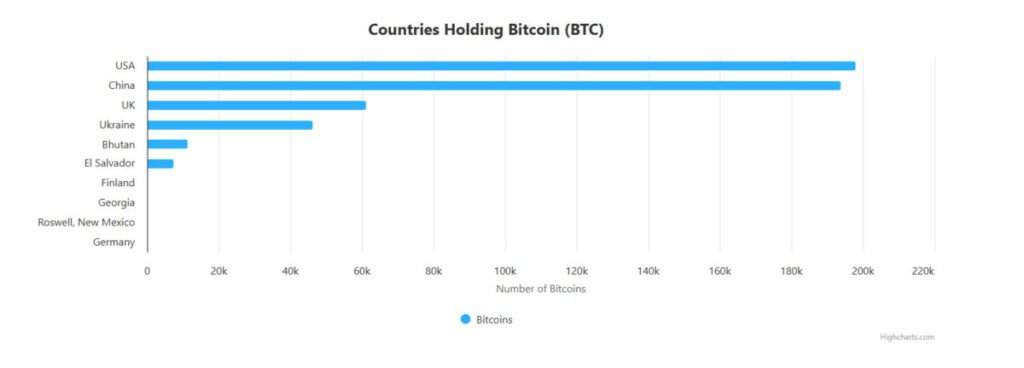
Government Bitcoin Holdings have officially entered the realm of geopolitical strategy as 2026 begins. Recent data from the Bitcoin Treasury Tracker indicates that the gap between the world’s two largest economies has narrowed to a razor-thin margin. While the United States has long been the dominant “whale” among nation-states, China is now just 4,012 BTC away from seizing the top spot.
Government Bitcoin Holdings and the Race for Dominance
As of late January 2026, the United States maintains a treasury of approximately 198,012 BTC. This inventory was largely compiled through high-profile law enforcement actions, including the historic Silk Road and Bitfinex forfeitures.
However, the Chinese government quietly holds an estimated 194,000 BTC. These assets were confiscated during the infamous PlusToken Seizure, a multi-billion dollar Ponzi scheme dismantled in 2020. Despite China’s domestic restrictions on private crypto trading, the state has refrained from liquidating this massive hoard.
- Advertisement -

| Nation | Bitcoin Holdings (Est.) | Primary Acquisition Source |
| United States | 198,012 BTC | Silk Road & Bitfinex Forfeitures |
| China | 194,000 BTC | PlusToken Ponzi Scheme Seizure |
| United Kingdom | 61,245 BTC | Money Laundering Investigations |
The Rise of the US Strategic Bitcoin Reserve
The narrowing gap comes at a time of radical policy shifts in Washington. Under recent executive mandates, the federal government has established a formal US Strategic Bitcoin Reserve. This National Crypto Strategy marks a departure from previous years when the U.S. Marshals Service would regularly auction off seized tokens.
By treating Bitcoin as a sovereign asset similar to gold, the U.S. aims to ensure long-term fiscal stability. Experts at Reuters suggest that this move was a direct response to the growing Digital Asset Arms Race, where holding “hard” digital currency is seen as a strategic advantage.
Nation-State Bitcoin Accumulation: Why This Matters
This “flippening” is more than a statistical curiosity; it represents a Sovereign Bitcoin Reserves milestone. If China surpasses the U.S., it would hold the largest state-controlled digital treasury in history.
For investors and C-Suite executives, this Nation-State Bitcoin Accumulation signals that Bitcoin has matured into a tool of statecraft. As countries like Bhutan and El Salvador continue their own mining and purchase programs, the pressure on major powers to expand their reserves only intensifies.
Also Read: Ukraine Bitcoin Holdings Reach 46,351 BTC Worth $5B — But Are They Truly Government Reserves?
FAQs
How did China acquire so much Bitcoin?
The bulk of China’s holdings comes from the 2020 crackdown on the PlusToken Ponzi scheme, where authorities confiscated nearly 195,000 BTC.
Does the U.S. still sell its seized Bitcoin?
No, under the current 2026 policy framework, the U.S. has halted all sales of seized Bitcoin to build its strategic national reserve.
What is a Strategic Bitcoin Reserve?
It is a government-held stockpile of Bitcoin intended to serve as a long-term store of value and a hedge against inflation or currency devaluation.
- Advertisement -