


– Ad –

| Getting your Trinity Audio player ready... |
- Massive Wipeout: A sudden market reversal triggered over $374 million in liquidations, punishing traders who bet on a post-rate cut rally.
- Fed’s “Hawkish Cut”: Despite a 25 basis point reduction, Chair Powell signaled that future easing is not guaranteed, citing tariff-driven inflation risks.
- Bitcoin Volatility: The leading digital asset plunged below key support levels as the “sell-the-news” event flushed out highly leveraged long positions.
Crypto Market Liquidations Surge After Fed Announcement
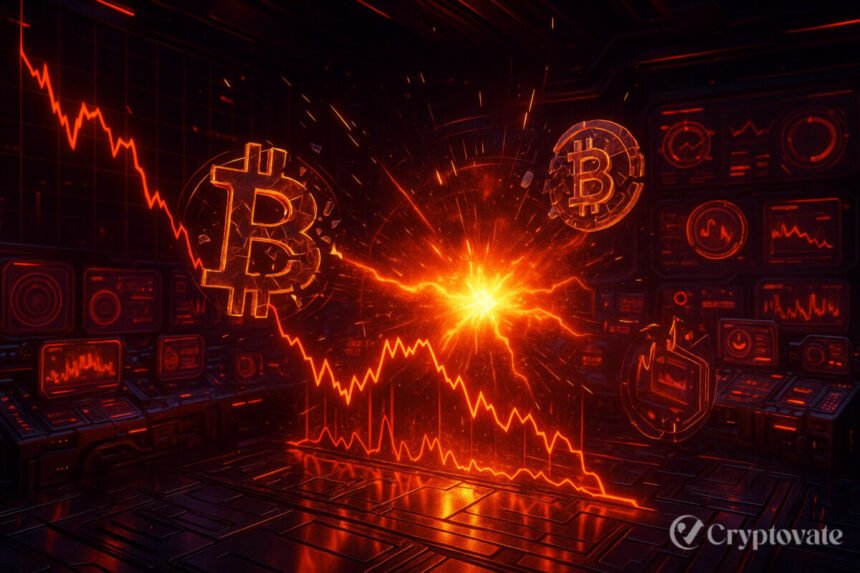
Markets took a sharp downturn immediately after Federal Reserve Chair Jerome Powell’s address, resulting in over $374 million in crypto market liquidations within a 12-hour window. Investors expecting a bullish surge from the December 2025 rate cut were caught off guard by the central bank’s cautious tone regarding the economic outlook for 2026.
This “long squeeze” flushed out over-leveraged traders who had priced in a more aggressive easing cycle. For those new to market mechanics, a liquidation occurs when an exchange forcefully closes a trader’s leveraged position due to a partial or total loss of the trader’s initial margin.
Bitcoin Price Drop & The “Hawkish” Pivot
While the FOMC delivered the anticipated 25 basis point reduction, lowering the target range to 3.50%–3.75%, the accompanying commentary sparked the sell-off. Powell emphasized that further rate reductions are not a “foregone conclusion,” creating immediate uncertainty.
This nuance caused a rapid Bitcoin price drop, sending the asset tumbling through support zones around $90,000. Ethereum and Solana followed suit, amplifying the losses across the broader blockchain sector. The market’s reaction highlights a classic “buy the rumor, sell the news” scenario, where the actual event failed to provide new bullish momentum.
- Advertisement -


Strategic Outlook: Why This Matters
The Era of “Free Money” is Not Back Yet The sheer volume of long position liquidations suggests that the market was overly optimistic. Traders ignored the macroeconomic headwinds, specifically the potential for renewed inflation driven by impending tariffs.
Fed Chair Powell effectively reset expectations, forcing institutional desks to re-evaluate their risk models for Q1 2026. This isn’t just a momentary dip; it signals a structural shift where liquidity might remain tighter than the crypto consensus expected. According to recent data from Bloomberg, the correlation between digital assets and traditional risk indicators like the 10-year Treasury yield is tightening, meaning crypto is less decoupled from traditional finance than previously thought.
Navigating Crypto Market Volatility
The fallout from the FOMC Meeting December 2025 serves as a stark reminder of the risks associated with high leverage during major economic events. Volatility is likely to persist as the market digests the reality of a slower rate-cut trajectory.
Smart money often waits for the “dust to settle” after such a Fed rate cut impact. The current landscape requires patience, as the initial flush of $374 million has removed significant froth from the derivatives market, potentially setting the stage for more organic price discovery in the coming weeks.
Also Read: Bitcoin Liquidations Hit $113M in One Hour as BTC Nears New All-Time High
FAQs
Why did crypto drop after a rate cut?
Markets often “price in” positive news weeks in advance. When the event finally happens without exceeding expectations, traders sell their positions to lock in profits, driving prices down.
What did Jerome Powell say to cause this?
Powell adopted a “hawkish” tone, warning that inflation remains a threat and that the Fed might pause future rate cuts if economic data suggests prices are rising again.
How much was liquidated in total?
Data indicates that over $374 million was wiped out in roughly 12 hours, with the vast majority coming from traders betting the price would go up (longs).
Will Bitcoin recover quickly?
Recovery depends on upcoming inflation data. If inflation cools, the Fed may soften its stance, but current tariff concerns suggest volatility will continue into early 2026.
- Advertisement -