





| Getting your Trinity Audio player ready... |
Key Takeaways
- An Ethereum whale sell-off risk is mounting after Garrett Jin transferred his entire 577,896 ETH position valued at $1.35 billion to Binance across four days in May 2026.
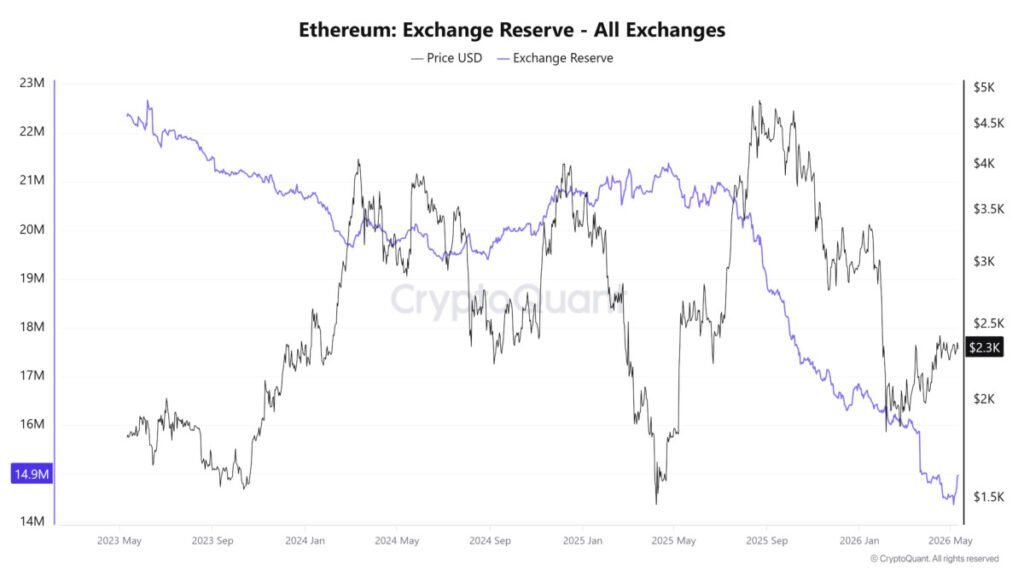
- Total ETH exchange reserves surged from 14.36M to 14.95M between May 5–11, amplifying sell-side pressure industry-wide and compounding the ETH Binance deposit concern.
- Institutional outflows from BlackRock and Fidelity plus $103.6M in ETH ETF redemptions on May 7 add a second wave of supply pressure on top of Garrett Jin’s deposits.
An Ethereum whale sell-off is rattling crypto markets after Lookonchain confirmed that trader Garrett Jin moved his entire 577,896 ETH position roughly $1.35 billion into Binance over four days. For anyone tracking Ethereum’s market mechanics, concentrated exchange inflows from a single wallet are a textbook signal of potential sell pressure ahead.
Jin built this stack by swapping Bitcoin for ETH eight months ago at $4,591. With ETH now trading near $2,330, the position carries roughly $1.3 billion in unrealized losses adding urgency to every transfer.
The Ethereum Whale Sell-off: How Jin’s Transfers Unfolded
Transfers arrived in batches 78,077 ETH ($178M), then 108,169 ETH ($250M) in a single day, and a final tranche of 225,627 ETH to complete the move. It is worth noting that an exchange deposit does not automatically confirm a spot sale; traders often park assets on exchanges for collateral or hedging rather than immediate liquidation.
Exchange Net Flow Data Confirms the Supply Build-Up
Jin’s ETH Binance deposit is not an isolated event. CryptoQuant data shows total exchange reserves climbed from 14.36M ETH on May 5 to 14.95M ETH by May 11. Binance alone holds around 3.62M ETH roughly 24.6% of all centralized exchange supply. Analyst Ted Pillows flagged repeated hourly inflow spikes throughout early May, calling the supply build-up a ceiling on price recovery.
- Advertisement -


Institutional ETH Outflows Amplify Crypto Market Volatility
Jin’s moves land alongside institutional-level pressure. BlackRock sent 11,475 ETH ($26.3M) and Fidelity followed with 23,919 ETH ($54.4M) to Coinbase Prime around the same window. US Spot Ethereum ETFs logged net outflows of $103.6 million on May 7, ending a four-day inflow run. Metalpha also routed 8,771 ETH (~$20M) to Binance on May 8 part of what Lookonchain called a continued pattern of large holders moving ETH onto exchanges.
Strategic Outlook: What This Means for ETH
Rising Bitcoin dominance combined with climbing ETH exchange reserves is historically one of the more dependable bearish setups in the altcoin cycle. Capital rotates into BTC during uncertainty, and the current data pattern reflects exactly that shift. ETH’s 4 hour chart still holds above the 50-period EMA near $2,329, with the MACD showing a fresh golden cross but RSI at 61 suggests no real conviction yet.
The critical question is whether Jin’s transfers trigger a cascade. If deposits continue and institutional redemptions accelerate, support near $2,200–$2,270 becomes the line to watch. A break there risks forced liquidations on leveraged longs. If buying absorbs the new supply instead, this exchange-reserve spike may mark a distribution peak—historically the precursor to a supply-shock recovery.
Also Read: Trump Media Q1 2026 Earnings: Decoding the $406M Crypto-Driven Net Loss
FAQs
What is an Ethereum whale sell-off?
An Ethereum whale sell-off occurs when a large-scale holder—commonly called a whale, moves significant amounts of ETH to a centralized exchange like Binance, signaling a potential intent to sell. Because such transfers increase the available supply of ETH on exchanges, they often create downward price pressure on the broader digital asset market.
Who is Garrett Jin and why does his ETH deposit matter?
Garrett Jin, also known online as BitcoinOG1011short and formerly the CEO of BitForex, is a closely watched crypto trader. His decision to transfer 577,896 ETH worth $1.35 billion to Binance across four days in May 2026 drew immediate attention because of the scale—one of the largest single-entity ETH deposits to a centralized exchange in recent months, raising crypto liquidation risk concerns across the market.
What happens to ETH price when exchange reserves rise?
When Ethereum exchange reserves climb, it typically signals that more holders are positioning to sell rather than hold in cold storage. This expansion in liquid, exchange-ready supply can suppress price recovery. Between May 5 and May 11, 2026, total ETH on centralized exchanges jumped from 14.36 million to 14.95 million a bearish on-chain signal that analysts monitor closely alongside Ethereum price analysis.
Does moving ETH to Binance always signal an imminent sell-off?
Not necessarily. Large holders sometimes deposit digital assets to exchanges for collateral purposes, hedging strategies, or portfolio repositioning rather than outright liquidation. However, the volume, speed, and context of Garrett Jin’s transfers given his deep unrealized losses from buying ETH at $4,591 make analysts treat this scenario as carrying higher crypto liquidation risk than a routine custody move.
- Advertisement -